AIOpt starts from the network data you already have, finds the likely cause, recommends a fix, and checks every change against your own rules before it runs. Every decision becomes a signed record you keep, and anyone can check it offline.
Safety checks before any change runs
Steps in one loop, from data to a signed record
One loop, eight steps
No change has been made to a live network yet.
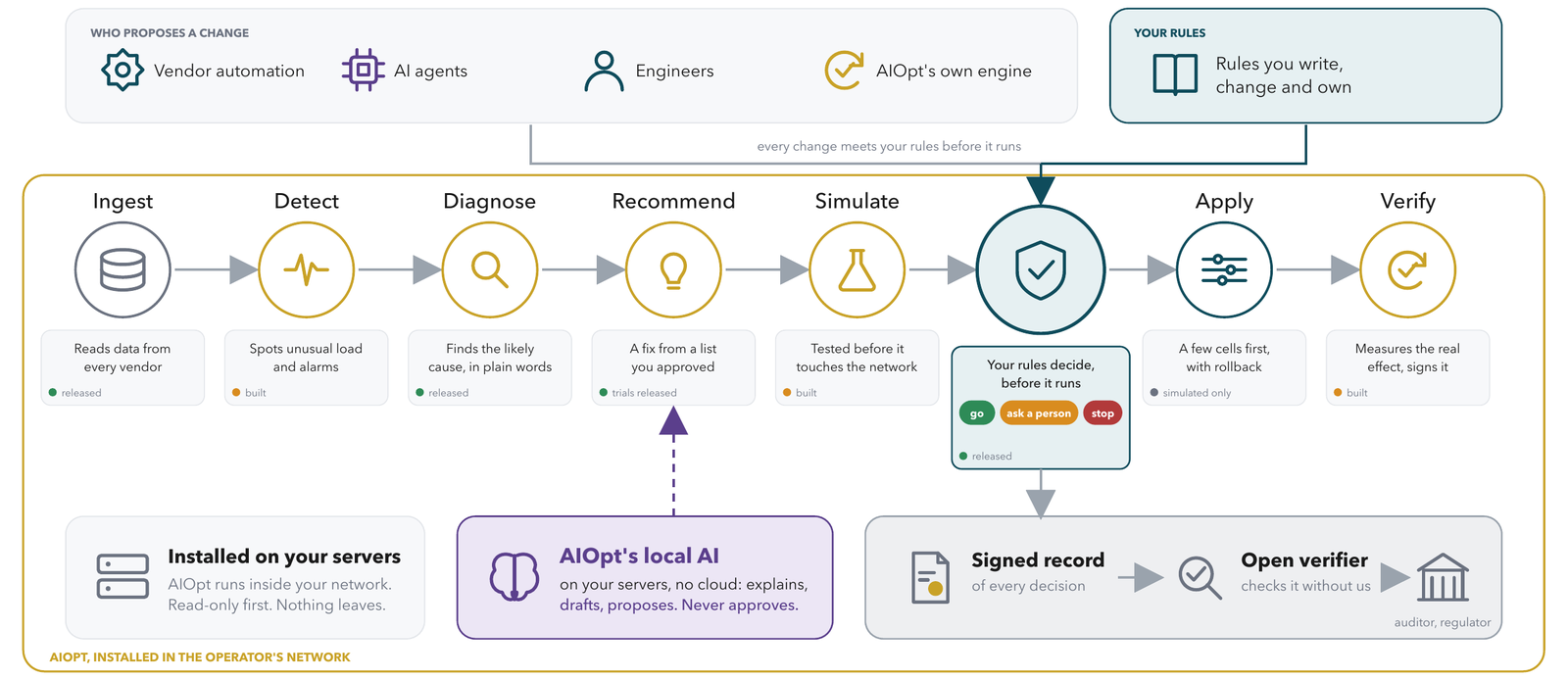
AIOpt is software an operator installs in its own network. One loop takes it from data to a safe, documented change: it reads data from every vendor, flags what moved, finds the likely cause, recommends a fix and tests it, then checks the change against the operator's own rules before it runs. The check is rules, not AI, so a wrong AI suggestion cannot pass on its own.
AIOpt refuses any action where the party proposing the change is also the party approving it.
Every decision is signed and exported as a pack that verifies offline.
Installed in your own network. Network data never leaves it, and no vendor cloud is involved.
Ships are built by shipyards and classified by DNV. Factories are run by their owners and inspected by SGS and Bureau Veritas. The separation is ordinary engineering practice, and it exists because a second pair of eyes catches what the first pair misses.
Mobile networks now need the same arrangement. AI is being given the ability to change live radio configuration, at a speed and volume no review board can keep up with. Those changes need a check that sits outside the system proposing them, and a record the operator keeps. AIOpt provides both.
Separation of duties is the design principle: the party that proposes a change is never the party that approves it. In AIOpt the check is rules, not AI, and AIOpt's own recommendations have to pass it like everyone else's.
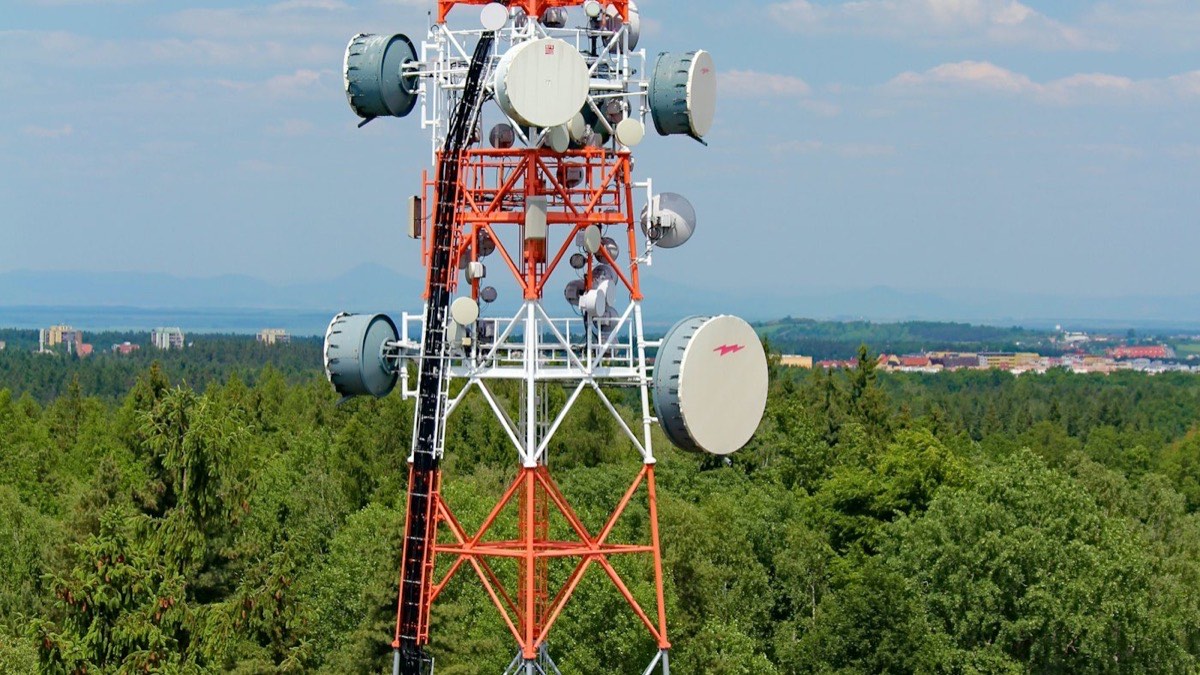
The equipment under change. Every automated adjustment to a live site is a decision somebody has to answer for.
Vendor automation, AI agents, engineers and AIOpt's own engine all propose changes. Every proposal meets the same seven checks before it reaches the network.
AIOpt checks the change itself, whoever wrote the model that proposed it.
A refusal names the rule that was broken and the value that broke it, in words an engineer can act on.
Approvals and refusals go into the same signed log, so the record shows what was stopped as well as what ran.
Four things AIOpt does, and you can check each one yourself.
Every proposed action passes seven rule-based checks before it can run, from safe limits to separation of duties. Your team sets the rules. A refusal always comes with a reason.
The checks refuse the patterns regulators named after real outages: a high-risk change with peer review skipped (FCC, AT&T, February 2024) and a risk level lowered by an algorithm without independent confirmation (CRTC, Rogers, 2022). We replay both, and AIOpt refuses each one.
Each decision can be exported as a signed pack, with an optional second signature from the change author and a public timestamp. Your auditor checks it offline, without our servers and without us.
The optimization track looks for possible improvements and measures their effect before anything is rolled out further. It only reads data and never makes a change itself. Anything it recommends still has to pass all seven checks.
Security: AIOpt prevents an unsigned setting from staying live: an alarm, then the value is put back under a rule the operator signs. Tested on a simulated network.
Every decision can be exported as a file package. Your auditor opens it on their own computer, offline, months later.
The operator's own key signs the pack. Change one byte of one record and verification fails.
The operator can co-sign every record with its own key. The free verifier checks each signature; making it insist on both is our next fix.
The pack gets a public timestamp, which proves it existed no later than the recorded date.
The verifier works on its own, with no AIOpt service, no account and no internet connection. Your evidence still checks out even if AIOpt is gone.
AIOpt is installed in the operator's own network. Network data stays there, no vendor cloud is involved, and the signing keys stay yours. This matters for operators who, by law or policy, cannot put network data in someone else's cloud.
In the latest release, v0.8.1 (October 2026).
Rule-based checks that run before any action
A signed log of every action, and evidence packs you can export
Built to standard interfaces, checked by our own tests
Runs in your network. Separate roles; unknown means stop
One full run: an incident arrives, the AI proposes a fix, the checks decide, and the record is signed.
About two minutes, with captions. The console runs on simulated data; the results shown are real output of our software on example inputs.
Run against a real 5G software stack in our own lab. No production deployment yet - the first operator pilot is what we are working towards.
Rule-based safety checks
Every AI-proposed action is checked before it executes3GPP TS 28.532 interface
Checked by our own testsAutomated tests
Counted on 1 October 2026. Latest release v0.8.1.Offline checks passed
Evidence pack from our public-data runSafe and documented changes for mobile and power networks: the problem, the principle, how the loop works, what we have measured and how to start. 14 pages, October 2026.
Read-only from day one. We work on change records you export, and we never need access to the live network.
30 minutes about your network and how changes are made and approved today.
A read-only pilot on your exported change data: past changes run through your own rules, and nothing touches the live network.
A signed record of every decision, and a report on which changes would have been stopped and why. You can check every record without us.
You decide the next step with the evidence in hand. Terms on request.
What we need from you: an export of your change history, the change rules you use today, and one contact person.
We work with operators, vendors, research groups and project consortia. Here is how each can start.
Bring a network problem or an export of past changes. We replay them read-only and return a signed report, and nothing touches the live network.
Send proposed changes from your automation through AIOpt's checks, so the network owner gets a signed record of each decision.
Bring an open problem or data you can share. We test ideas on simulated and public data, and we agree together what gets published.
In EU and national projects, we can join as the small company partner or own a demonstrator built on the AIOpt platform.
To start, send a few lines about the problem or project, and the deadline if there is a funding call.
Want to see what the checks say about your own change data? Book a 30-minute call, or write to us.